🌿 15% off your first order - for yoga lovers done with toxic foam mats. Use YOGA15 at checkout


Wellness & Movement
Most yoga mats are quietly exposing you to chemicals. Here is what we switched to instead.
After years of practising on synthetic rubber mats, we looked into what is actually touching our skin during every session. What we found changed everything about how we think about yoga.

AS FEATURED IN



AS FEATURED IN
I have been practicing yoga for fourteen years. In that time, I have owned six different mats — rolled, folded, sprayed, washed, and eventually replaced all of them. What I never once thought to ask was this: what exactly is that mat made from?
And more to the point, what is it doing to my skin, body and practice for the hour I spend on it every single day?
That question came to me unexpectedly, not during a yoga class but during a conversation with a friend who had just turned 57 and was trying to reduce the number of synthetic materials in her home. She had started reading labels. She pulled up her yoga mat's product page on her phone and looked at us both blankly. "It just says PVC foam," she said. "And I've been buying these for twelve years."
We started looking into it together. What we found was not alarming in a dramatic, headline-grabbing way. But it was enough to make both of us put down our current mats and search for something better.
What is actually in most yoga mats
The majority of yoga mats sold today are made from PVC — polyvinyl chloride — or thermoplastic elastomers (TPE). To make these materials soft, flexible, and durable, manufacturers use a class of chemicals called phthalates. These are the same plasticisers that have been restricted in children's toys in many countries because of questions about their effects on the endocrine system.
Why this matters for practitioners
Research published in the journal Environmental Health Perspectives has linked long-term phthalate exposure to hormonal disruption, particularly in women over 40. Since the skin absorbs compounds during sweating, a hot yoga class or a vigorous flow session on a PVC mat may increase contact. The mat you have owned for three years may also off-gas differently than a new one — some phthalates break down with heat and UV exposure over time.
Beyond phthalates, many standard mats contain heavy metal stabilizers used during the manufacturing process, as well as antimicrobial additives — often triclosan — that keep the mat smelling neutral but have been flagged by the FDA for potential hormonal effects. None of this appears on the product label.
This is not a call to alarm. Most people who practice yoga on standard mats are fine. But if you are the kind of person who thinks carefully about what you eat, what you clean your home with, and what products you put on your body — it is worth thinking about what you lie down on for sixty minutes a day.
"The mat you lie on for sixty minutes a day deserves the same scrutiny as anything else you put on your body."
What we found when we actually went looking
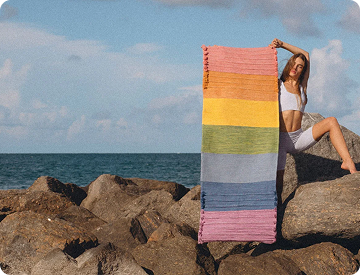
After going down a fairly long research path, my friend came back with something unexpected. She had found a small brand that was doing something genuinely different — not just marketing itself as "natural" while swapping one synthetic for another, but building mats from certified organic cotton, dyed entirely with Ayurvedic medicinal herbs and flowers, and handloomed by artisans using a traditional process.
The brand is called Öko Living. It is a small operation, not a mass-market name. But it has been recognized by Yoga Journal as the number one most sustainable mat of its year, covered by Forbes and GQ and Well+Good, and quietly built a devoted following among practitioners who discovered that a cotton yoga rug handles very differently from the rubber mats most of us grew up using.
Free shipping on orders over $150 · 30-day guarantee
Why cotton? And what does herbal dyeing actually mean?
When most of us think of yoga mats, we think of rubber — thick, grippy, slightly spongy. A traditional cotton yoga rug is a different object entirely. It is woven rather than moulded, which means it breathes. It gets softer with use rather than degrading. And because it has natural texture, it grips your hands and feet through moisture rather than losing traction as a rubber mat does when you start to sweat.
The herbal dyeing process is where Öko Living parts ways entirely from conventional manufacturing. Each mat is dyed using between 10 and 20 plant-based compounds — things like indigo, turmeric, madder root, and neem — that have been used in Ayurvedic practice for centuries. This is not a color treatment applied over a synthetic base. The cotton is immersed in herb-infused baths, which means the dye carries the properties of those plants into the fabric itself.
WHAT MAKES THE ÖKO MAT DIFFERENT
The full story, without the marketing language
These are the specific claims the brand makes — and they are all verifiable:
✓ Certified GOTS organic cotton
✓ 20 Ayurvedic Herbs
✓ Grip improves when you sweat
✓ Natural tree rubber base grip
✓ Zero PVC, BPA, or phthalates
✓ Naturally antibacterial fabric
✓ Handloomed by skilled artisans
✓ Biodegradable at end of life
The mat carries a natural tree rubber base that keeps it from sliding on studio floors, so it behaves like a conventional mat in that sense. But the surface you practice on is entirely organic cotton — no foam, no plastic, no chemical coating.
What it actually feels like to practice on one
The Oko Living cotton mat offers a medium grip, designed to support how your body naturally moves rather than locking you into place. Instead of relying on an overly sticky surface, the mat encourages your stabilizing muscles to stay engaged, helping activate your core and support stronger posture and better alignment during practice.
This matters because balance, alignment, and strength are not just about flexibility. When your muscles stay lightly engaged, your body works more naturally to support movement, helping build strength and body awareness over time.
Many plastic mats use an artificial grip that keeps holding even when your muscles relax. While this may feel secure at first, it can reduce natural muscle engagement and sometimes place extra strain on muscles and tendons as the body settles into positions without proper support.
The difference feels subtle at first, but over time many people notice a practice that feels more balanced, supported, and connected to how the body is meant to move.
The testimonials that carried the most weight
The reviews that convinced my friend to try this mat were not from influencers. They were from long-term practitioners who described the mat with the kind of specificity that only comes from actual use.

"I've been doing yoga on a Manduka Pro mat for 10 years, 250-hour certified RYT. These Öko mats are way better. The cushion, the grip that gets better as you sweat, the ridges in Down Dog — nothing compares."
Sarah M. Verified buyer

"Practising on this mat is an act of self-love. Soft, with just enough catch to hold poses. My skin just feels good touching it. The natural fibres and herbal dyes are everything yoga should be about."
Paige Ashley. Verified buyer
"I wanted it because it's gorgeous. But I didn't expect it to also have great traction and work better for my knees than anything else I've tried."
Skye M. Verified buyer
The honest answer on price
This is the part of the conversation that comes up every time. Öko Living mats start at around $170 and run to $250 for the thicker deluxe models. By any standard comparison to what you find at a big-box sporting goods store, that is a significant number.
But consider the actual cost of how most people buy yoga mats:
| Option | Cost | Lifespan | Notes |
|---|---|---|---|
| Budget PVC mat (replaced every 12-18 months) | $25-$40, four times over five years | 12-18 months each | Peels, smells, loses grip |
| Mid-range rubber mat | $80-$120 | 2-4 years | Better, still degrades |
| Öko Living herbal mat | $170-$250 once | 5-10+ years | Gets softer and better with age |
Cotton yoga rugs, when properly cared for, do not degrade in the way foam or rubber does. They get washed, they get softer, and they last. Over five years, the economics are considerably closer than they first appear, and the material you are practising on every day is categorically different.

30-Day Practice Guarantee
Öko Living guarantees you will feel a difference in your practice within 30 days, or they will refund your purchase. No complicated process.
Who this is - and is not - for
If you practiceprimarily with vigorous, fast-flowing sequences and have built your muscle memory entirely around the sticky resistance of a PVC mat, there will be an adjustment period. It is not a difficult one, but it is real. The cotton surface grips differently — better in some ways, different in others.
If you practiceIyengar, Hatha, Yin, Restorative, or any form that involves holding poses for longer periods, this mat is probably close to ideal. The cushion is real, the grip is dependable, and the experience of lying in Savasana on natural cotton versus synthetic foam is, without exaggeration, noticeably different.
If you have been thinking more carefully about what you expose yourself to — in food, in personal care, in your home — adding the same consideration to a mat you practiceon daily is a natural next step. It is not a dramatic change. It is just a considered one.
Find your mat
Öko Living offers several weights and patterns. The collection page walks through the differences clearly, and every mat ships with free returns.
✓ Free shipping over $150
✓ 30-day guarantee
✓ Ships within 3 days
© Öko Living2026. All rights reserved. | Privacy Policy | Returns & Refunds